 Enter the future of localization with Hera AI, InText’s automated post-editing, LQA and QE tool that takes context into account.
Hera AI improves machine translation quality and reduces localization costs by combining the speed and scalability of machine translation with the contextual intelligence of LLMs.
Automatically post-edits machine-translated bilingual files based on reference materials — including translation memories, glossaries, and style guides — to ensure consistent, high-quality output.
Reviews bilingual files against customizable LQA rules defined for a particular project or language pair, ensuring compliance with your quality standards. Operates in comment mode, leaving the original translations unchanged.
Evaluates bilingual files according to TAUS Post-Editing Guidelines and identifies which segments require light, full or no post-editing. Operates in comment mode, leaving the original translations unchanged.
Generates translations directly from the source file into the target language while maintaining high quality through contextual understanding across multiple segments.
Language service providers (LSPs)
Speed up post-editing, LQA, and QE, reduce costs on linguists’ work, and handle even low-budget requests profitably without sacrificing quality.
Linguists
Improve the quality of MT output before editing, get instant QE and LQA feedback, so you can work faster, reduce repetitive fixes, and take on more projects.
Enterprises
Optimize your localization team’s productivity while cutting costs and without compromising on quality.
The overall impression is very positive. Context-aware AI-editing leads to a clearly noticeable improvement in quality.

Hera AI has cut our time per segment in half. Overall, it’s been a very positive experience. With this kind of text preparation and non-technical subject matter, it takes me on average 40 minutes for every 1000 words. I think it’s awesome.


Read more useful articles on our blog >>>
Right now, we are actively developing new features for Hera AI. Upcoming releases will include:
We welcome your suggestions for features or improvements that could make Hera AI more useful in your work.
Your data security is our priority. Hera AI does not store your input data or use it for training purposes.
Your uploaded files are transmitted directly from your device to OpenAI for processing. OpenAI guarantees that content submitted through its API is not stored, logged, or used to train models. All processing happens in a secure, one-time interaction, ensuring your content remains fully confidential.
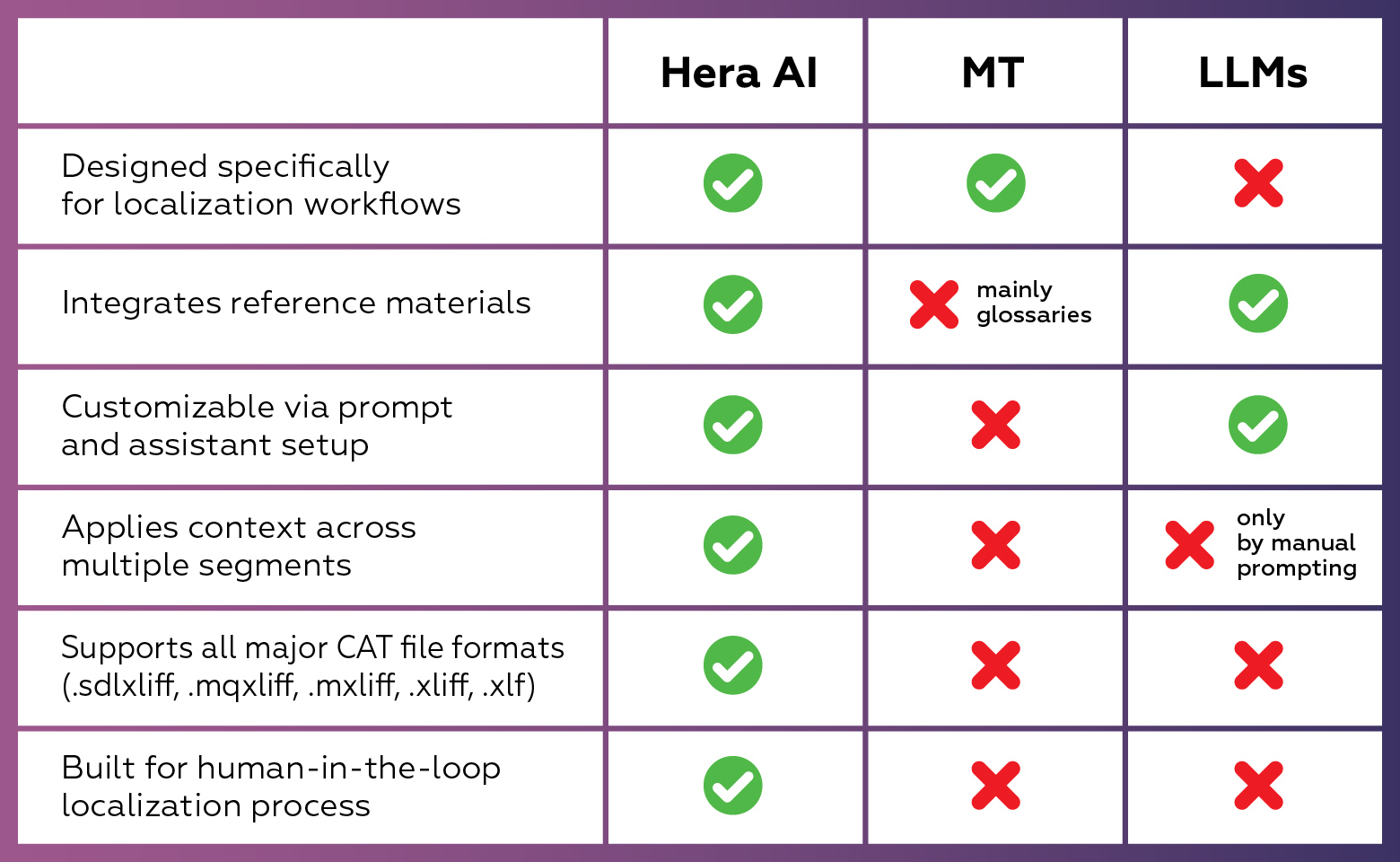
Hera AI works directly with bilingual file formats, allows you to integrate reference materials, and applies context across multiple segments (not just one at a time). It also identifies logical inconsistencies in the source text and takes them into account, reducing the risk of errors.
With Hera AI, your data remains fully confidential. Hera AI is a desktop application. It does not store files on InText servers, and the app itself does not retain or reuse your content for training. When you process segments, they’re sent directly from your computer to the LLM provider via a secure API connection for one-time processing. The provider doesn’t store, log, or learn from your content — your translations stay private.
Hera AI processes combined segments in a single request to the LLM. This is faster, more efficient, and more cost-effective than processing segments individually with large context windows.
Hera AI supports all major languages. However, output quality is highest for the most common language pairs. For rare combinations, we recommend using English as a pivot language between the source and target.
Hera AI currently supports .sdlxliff, .mqxliff, .mxliff, .xliff, .xlf bilingual file formats from Trados, memoQ, Phrase, Crowdin, Lokalise, Smartcat, Smartling, Wordbee, and XTM. Note that Hera AI works with exported bilingual files and does not connect directly to CAT tools.
Absolutely. Thanks to its broad contextual understanding, Hera AI recognizes incorrectly broken segments and adjusts the translation accordingly.
Yes. Hera AI applies your existing translation assets across the number of segments you define, improving consistency and reducing the need for manual editing. You can import them in .doc, .docx, or .txt formats.
Unlike basic machine translation tools, Hera AI processes bilingual files, applies project-wide context across batches of segments, and supports reference materials, resulting in more consistent and accurate output. Hera AI doesn’t replace machine translation — it improves it.
We provide ready-to-use prompts for using Hera AI in different scenarios. You can use them as-is or customize them to fit your specific workflows. To modify the prompt, simply use the Update button and describe what you’d like to achieve in plain language. Hera AI will then refine the default prompt for you.
In our experience, standard machine translation tools alone don’t meet the quality expectations of our clients, while human experts are typically reserved for high-priority or sensitive content. To strike the right balance, we’ve developed Hera AI, which ensures both high quality and cost-efficiency.
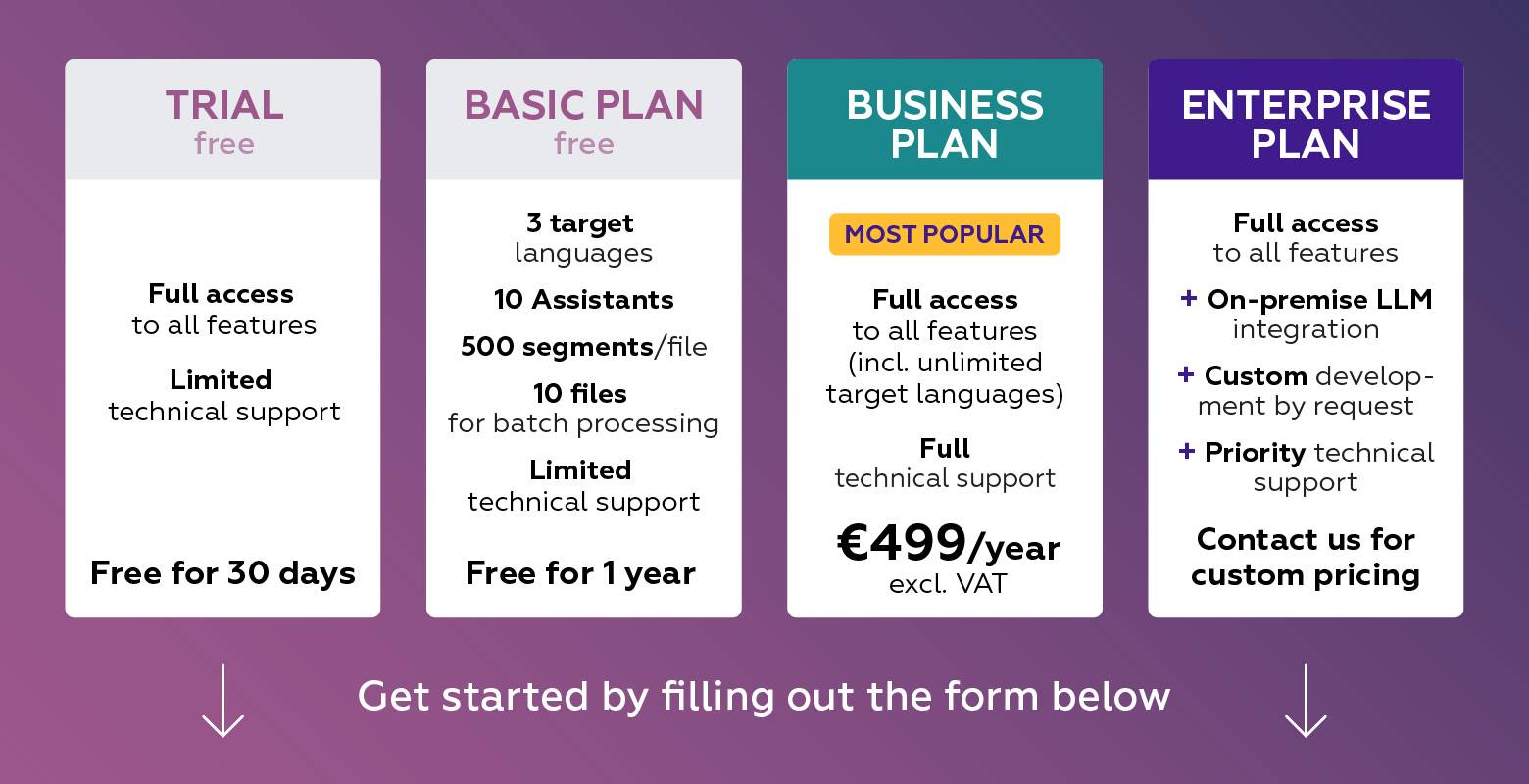
Shape the future of localization by filling out the first form below, downloading Hera AI, and starting a 30-day free trial. After filling out the second form, you will also be able to purchase both free and paid plans of Hera AI.
Hesitating? Schedule a demo, or email us at hera.ai@intext.com.
For technical questions or support, you can reach us at hera.ai@intext.com.