22.10.2026
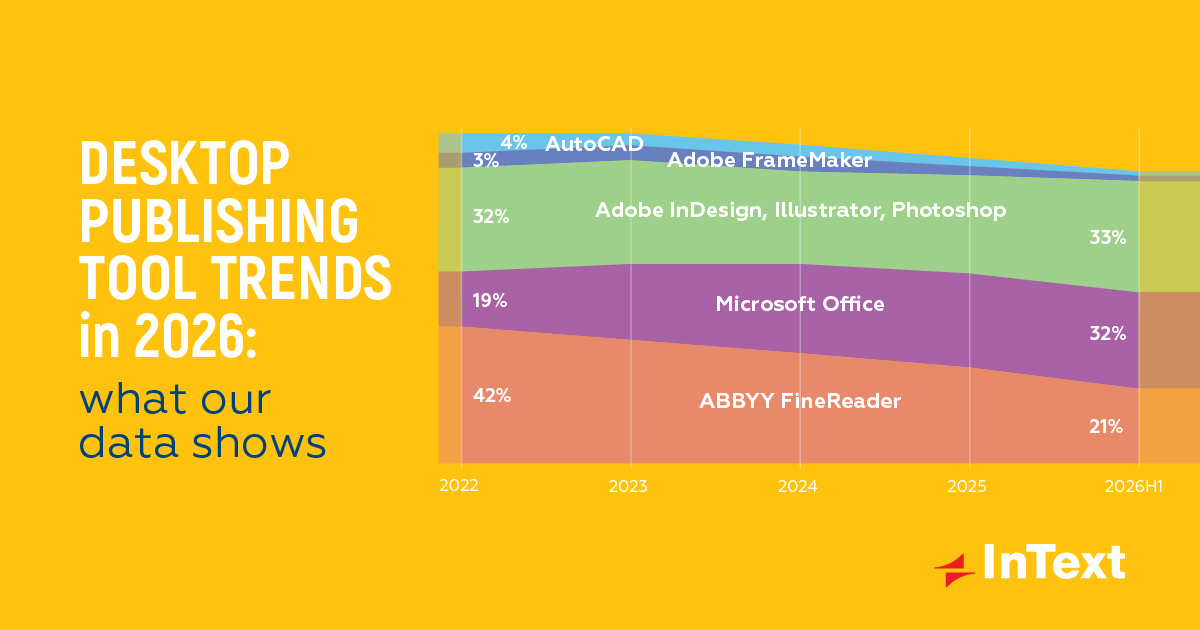
Who would’ve thought that everyday Microsoft Office tools could nearly match Adobe graphic design software as a percentage of our document engineering workload?
To see how our use of tools has changed over time, we looked at how our team’s work hours were distributed across different software packages from 2022 to the first half of 2026. Here’s what we found:
- Adobe InDesign, Illustrator, and Photoshop combined continue to account for the largest share (33%), with only a 1% increase since 2022.
- Microsoft Office is now just one percentage point behind Adobe graphic design tools, accounting for 32% of recorded desktop publishing hours in 2026, up from 19% in 2022.
- FineReader’s share has dropped by half since 2022, from 42% to 21%.
What could this mean for fellow LSPs and document engineering specialists?
- Adobe graphic design tools have maintained a relatively stable share. We expect this trend to continue in the near future, as AI hasn’t yet had the same impact on all types of layout and design tasks.
- Document processing work isn’t limited to specialized design software. Even familiar Office tools can involve complex formatting and layout tasks, requiring substantial time and deep expertise to prepare files for localization.
- The decline in FineReader’s share might suggest fewer scanned documents requiring re-creation and more editable files that still need careful layout work.
Looking ahead, we expect the role of document engineering specialists to evolve. By 2030, as routine layout tasks become increasingly automated, complex workflows, system-dependent layout, and quality assurance may become more essential and require greater attention and expertise.
For content solution providers, these developments point to the necessity of reviewing document processing capabilities to identify which skills you might develop in-house or where specialized partners like InText could provide additional support.
